An Interview With Becky Stark
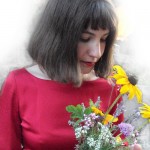 What is folk?
Becky Stark (L.A. Ladies Choir): What is folk and what isn’t folk. I must confess that I love all music. I love pop music. I listen to the radio. I love jazz. I mean, jazz?! What isn’t folk music? Folk isn’t something that one person can make that other people can’t make. Folk music is something you’re demonstrating that could belong to anyone. This is going to be bad to say but, for a long time, that lady, what’s her name? “Heathcliff, it’s me your Kathy, I’ve—”
Kate Bush.
Kate Bush. I couldn’t listen to it. What’s the point of this music because it seems so individualistic? Joanna Newsom is not folk music to me. You couldn’t make it. Her mastery of the harp, to me, that’s not folk. “This land is your land” Pete Seeger, Bob Dylan, can belong to anyone. Something rarefied that’s more an individual narrative comes from a culture of individual attainment.—But, see, that’s not necessarily true. What one creates everyone creates, because we are all one anyways. What one person achieves, everyone achieves. It’s not what you’re taught but it’s reality. You want each individual to accomplish whatever greatness they can accomplish because that expands the whole experience of possibility for everyone. It’s an old argument, a royalist vs populist argument. Music like Kate Bush or Joanna Newsom is royalist to me, not populist.—But it’s beautiful! I love music that has incredible virtuosity. Folk music has virtuosity, too. To say there’s no virtuosity in folk music is totally false! Let music belong to everyone. Who knows, gosh, maybe if that idea pervaded, we could have a culture where virtuosity was abundant.
Does folk music express a need to rebel against mass culture?
Definitely, there’s an abiding need to create a counterculture. That scene of rebellion and creativity which can belong to everyone was happening at The Smell when I first moved here. There’s a direct through-line from the L.A. punk scene to the L.A. folk scene. Anybody could play. I knew two chords and I would play at the Smell, improvising songs. That spirit of free space—where everybody shares whatever they want because it’s human truth—is directly related to needing to create a counterculture in reaction to the pervasive insanity of American culture. We get numb to how profoundly repressive our culture is.
What do folk and punk culture have in common?
They have the same liberated spirit, an ethos of liberation or belonging to everyone. To me, folk or punk is the same thing. The idea that anyone has the right to participate and be creative. It’s part of your nature and good for you like breathing or eating or planting a garden. The more people involved, the stronger the community. Not seeing music as something special that belongs to certain people, or that value comes from external accomplishment. It’s not your place to judge your creativity. It’s your way of being, to let yourself create what you’re inspired to create. This whole idea of art or an artist being special, it seems cruel. It’s attached to fascism, really. It keeps people thinking they don’t have any power. Creativity is power. You experience your own power, your own strength, to make something. Take responsibility for your desire to be creative, regardless of if you make money or a career. Just respect your own desire to express and create. That’s a way of being liberated, you know?
How does music reflect the culture it comes from?
Sometimes I feel about the music in our culture the way I feel about the food. There’s no food in the food and there’s no music in the music. When I eat some food, it’s like, there’s no food in this food! Music is a very powerful source of energy and strength and if it’s appreciated that way, it can have the possibility for creating transformation. A musical culture is a beautiful thing for people to participate in. It is an act of rebellion to be involved in making the world more beautiful, claiming your power to create your life and create your community. Hopefully in L.A. we can take what exists in our community and grow it into something powerful to create cultural change. Our culture needs to be more honest about our relationship to value, meaning, money, to ourselves. We are rewriting so much of the meaning of our culture because our whole system is failing.
What brings about a need for folk music?
There’s a lot of grief over power, value, and money. What gets expressed becomes this need to reclaim personal power regardless of our relationship to wealth or ownership. Folk or punk comes in here. But then it will get co-opted by the mechanism of American society: Whatever is the most rebellious becomes the most American. That’s why people say philosophically there can never be a revolution in America. Whatever is the most subversive gets enveloped and brought right back to the center. Then it’s not critiquing anything anymore. In order to rewrite society based on real values, we have to be able to develop a new relationship to meaning and power and money and creativity.
Does this description apply to your community?
Yes. What’s beautiful about Los Angeles is there is real folk or punk having a real cultural proliferation of creativity and value. It seems like a paradox that your individual life could make a difference. But understanding that is really liberating. L.A. music culture exists in this place where people crossover between genres and social classes. There’s an operating principle based on what I would call “true value,” valuing creativity, valuing the earth. The most radical path is creating a really powerful local culture. That’s the answer. Empowerment in a totally micro way.
Is this a time of change?
The change we’re undergoing is similar to when people thought the earth was flat but really it was round. I think actually the world isn’t round. The world is a hologram. In a hologram, you can’t separate the part from the whole. If it was a hologram of this bookshelf in front of us and I tried to take out…that book, “Deconstruction In Context”, it would be impossible. Each part contains information for the entire whole. It’s possible that we’re on the verge of some shift like that.
How does this relate to forming a community?
That’s the essence of building community. The thing that gets most in the way from moving towards a new world that’s sane, kind, beyond conflict, beyond conquest of the earth for profit, is that people individually think they don’t actually have a direct relationship to the world. What they do doesn’t matter. If you understand the reality that you have power and you have a direct relationship to everything, it changes the whole game. When you build power through a community, at the essence is the belief that everyone has power. When you build that in a real way, it totally changes your relationship to yourself. The paradigm that there’s nothing that anyone can do, that’s cynical. That’s a false reality.
What is unique about L.A. music culture?
I moved here about eleven years ago and I’ve been pretty involved in the music community since. I found it to be beautiful, very open and alive and wild and free and friendly and loving. Maybe it doesn’t exist anywhere the way it has in the last period of time in Los Angeles. There’s an ethos among the musicians that is so inspiring. People listen to each other and there’s a sense that the community of artists can grow infinitely. That is the essence of what folk music means, or what folk community is—this experience of music that belongs to everyone if you want it. It’s part of your humanity that’s available for everyone as a source of strength and beauty and healing and pleasure and community. That’s what I love about L.A., or California. There’s something unusually Utopian here. There’s something pure about the way the community lives and grows. People play music in different styles and people listen to each other.
What brought Ladies Choir into being?
I had this desire to sing with a group of women as a healing experience. It’s like bathing in sound. It feels good. Having a big group of people together to do anything is totally hilarious and chaotic and ridiculous, but on the balance everyone in the Choir will tell you that it has changed their lives for the better. Singing together has strengthened us as a community, bonded us, created friendships and harmony. It’s such a good practice for how to be a more peaceful person. I’ve been thinking about it a lot. I had a deep desire for harmonies. It feels good to sing in harmony. It feels nourishing. It’s like healthy food. It’s formative. Living Sisters has a joke. We like to say, “harmony is real.”
—Daiana Feuer
Leave a Reply
Recent Posts
Sponsors
 |
 |
 |
 |
 |
 |