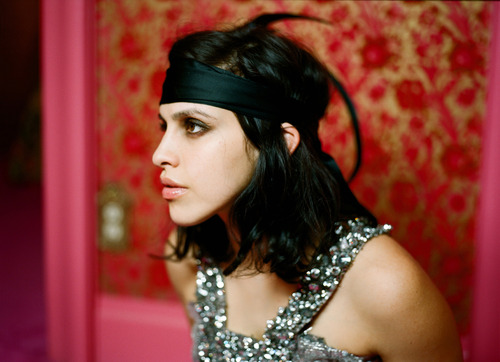
An Interview With Ariana Delawari
What is folk?
Ariana Delawari: For me, it has to to do with storytelling. Having a message. It has to do with community, sharing what we see and feel in an intimate way. Telling a story with the intention of connecting and expressing a view and personal experience. It’s also commenting on our shared collective experience, our history, and our connectedness. It’s sort of like road trip stories.— Even when it’s super intimate and it’s one person singing alone on stage, it’s shared. There’s a storytelling aspect. You can have electronic elements or whatever in terms of genre, but once there’s this storytelling personal aspect, that to me defines folk music.
Growing up in Los Angeles, how was folk music a part of your life?
The beginning of folk music in my life was Afghan folk music. I grew up in a culture where there were always live musicians, even at a tiny gathering. Also my mother was really into Willie Nelson and Johnny Cash, so I grew up on all that old school country music. I started playing acoustic guitar at 13, which lends itself to American folk music, which led to exploring that world. It wasn’t until becoming friends with a lot of the friends I have now, that this sort of a folk wave took over L.A. again. Around 2006, all my friends were playing folk. There was this moment where Devendra Banhart, Becky Stark, Jonathan Wilson, Erica Garcia, who used to be in Mountain Party, and even Guy Blakeless from Entrance—we were all at the same time experimenting with our own folk music. It was exciting. All this stuff was happening. I met Devendra and Erica and Hecuba and Guy and Jonathan all around the same time.
What do you think prompted this interest in folk music?
There was a need for folk music. It was the Bush administration still, and people were frustrated with American politics. It birthed a collective need to return to music that had a message and organic personal quality. For me, going back to Afghanistan and spending time with children and refugees, it was all in my heart. There was just a shift of spirit. We were all tuning into this frequency that had more to do with getting back to the heart. We’d go to a party and there’s instruments and guitars and people making songs and playing. I think that’s rare how that resurfaced. I don’t think that was happening 10 years ago. It was a shift in consciousness. It was synchronicity, meeting these people, who all came together. And Arthur Magazine was a part of it. There was a lot of experimentation. We weren’t regurgitating the past. We were using different instrumentation and sounds, and mixing things together.
Your lyrics are very concise and deliberate. What is the poetic drive to your songwriting?
I grew up really revering poetry and reading a lot. I love words and finding the right words to express what I want to say. When I write a song I am always writing with the intention of sharing what’s in my heart in order to connect with everyone else. I think the simpler the better. The more universal we are in what we’re saying, the more we are all going to relate. For me, it’s really about connecting. Even if it’s a political issue, I want to bring it back to what makes us human and similar.
How did this evolve with your debut album, Lion Of Panjshir?
My intention with the album was to write something really personal so that these larger political ideas come through my heart and my life, so that it wasn’t alienating to anyone. If someone doesn’t know anything about Afghanistan, they still know about wanting to have a home. If I’m writing something political that has to do with the Soviet invasion and the Taliban, on a sentimental level the idea is we all want to have a home. I also wanted to write love songs. I wanted to give a full-rounded picture of what’s important. I also care about romance and love and friends and life.
Are you at all worried about being taken too seriously?
I don’t even think of the statements I make as being bold. They’re right in front of all of us. We live in this world together and we all see things. I happen to have seen a lot of Afghanistan from traveling and it was such a part of my family’s life. It wasn’t like, “I am going to make a political song.” I had a dream that I was being chased by the Taliban and I wrote a song about it. It was part of my life. Not because I wanted to make one, but because I wanted to play with the Afghan musicians. Traveling to new lands to do an album, I wish everyone would feel that urge with their music. There’s something so beautiful about collaborating with new people and sharing the folk experience. What’s different with folk music, too, if you look at it historically, they always invite their friends to sing along. That was the spirit I started to see with our friends. ‘And now this person is going to sing with me here, and then that person.’ Breaking the wall between performer and audience so that it’s more collective. I think that’s the contrast with pop music, which is more presentational.
If you were to venture into other music styles, would that have to change?
No, and I want to venture into alternate styles of music. That’s where I’m headed. But I want to carry the spirit of folk music into that. Even if the sounds and production change, I will always carry the spirit of connecting and telling stories from the heart and soul and for people in the room to feel incorporated so that there isn’t a barrier between the stage and the audience. With politics shifting, sounds are changing again. With the economy now, people feel sad. There’s a shift towards dance music. People want something to keep their hopes up. Like when musicals came out in the 1930s, people wanted all technicolor and to be entertained. But this period was a heavy time. It’ll be a hybrid form though. Folk gone dance. I think we’re part of a movement. I really do. I think we’re all going to look back on this period of time and see we were a part of something.
—Daiana Feuer
Leave a Reply
Recent Posts
Sponsors

| |
 
| |
 
| |
Twitter Feed
Folk Fest Raffle!