An Interview With Featherbeard
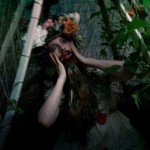
What is folk?
Featherbeard: I don’t really make folk music; I grew up listening to it. Be it Bulgarian or Ethiopian or American, it is very much a shared set of songs and stories, like these ballads that passed form Greece to Germany to America that have a long tradition. Someone wrote these songs at some point. In the 20th century, musicologists wrote them down but for a great majority of time the songs were passed through oral transmission. I think I am spouting some academic idea of this. This music is a big part of my musical upbringing. I was lucky to have grown up going to this week-long folk festival. I heard Jene Ritchie and I didn’t know she was something beyond a beautiful voice, a part of what happened in our contemporary culture to preserve these songs. Other things have been swallowed by mass media.
Do you mean by the recording of music?
The way we pass songs along is different now. In the 1930s they did field recordings as technology gave them the ability. That same technology that was able to preserve it destroyed the transfer of these songs as ‘just your mom washing dishes,’ or ‘sitting around outside the mines.’ That’s the music that I would call, academically, folk. Our culture changed with technology. There is an aesthetic that sounds like that. There’s a difference between produced pop and one person with guitar or four with acoustic instruments that the term ‘folk’ began being applied because it shared this aesthetic with the old ballads. There was a strong emphasis on words. They were stories. This was the main form of entertainment.
If I record you making up a song* at a show, that is the only way it can be preserved, otherwise it exists only in the audience’s memory and it can’t be shared otherwise.
That’s true. I am not opposed to the technology. Without recording or preservation, it’s just in someone’s memory. I was lucky to see Jean Ritchie but not lucky enough to see John Jacob Niles. But this is part of the reason that music changed. You don’t need to keep singing the same song over and over anymore. We can continue to build and write more songs. There’s not a burden of memory. This is the reason that song-sharing was their medium. That was their recording device.
Is this why there’s so much disposable music?
Yes. I don’t remember any facts about nations. I can look it up on the computer. That information to me as a body and mind is much more disposable because of technology. At the same time, it’s beautiful because you have this enormous library now. The 20th century breaks from history in a big way. We continue the battles of violence and things but it’s so different. How tall could a building be 150 years ago? There’s the pyramids, of course, but they’re not these thin phallic things shooting up in the sky.
Why do you make the music you make?
Because of my upbringing with folk. ‘I can do it.’ The punk and folk ethic overlap here. ‘The people can do it.’ In that way, some of what I play is called ‘folk.’ I have a guitar and a voice; I can play and sing. I stumble upon chords and I don’t know what they’re called. Words are important to me. Poetry, sound, melody, the more unification you can get the more I am interested. I’ve never been able to afford electric instruments. There’s an endless amount of machines. I need a microphone or no microphone. Maybe poverty is a part of folk. You have to work with what you have. Coal miners were below regular people. Talk about an age lacking celebrity or mass media. People weren’t making money. That’s why it was so beautiful.
What was the week-long festival you mentioned?
Family Folk Week at Hindman Settlement School. In a tiny town in Kentucky in Knott County next to Hazzard County, made famous by Dukes of Hazzard. A creek runs through it called Troublesome. Ritchie is from Knott County. I met old timers I can’t hardly understand. I recorded Morgan Sexton narrating how to make moonshine. The first time I heard it, I recognized three words as English. He is this toothless banjo player. These guys made their own banjos from animal skins from what they hunted for dinner. It was amazing to experience them. My generation is the last that will meet these people.
What have you found in Los Angeles?
I came from New Orleans. There’s a huge gypsy and circus scene there. It’s a wolf pack where if you’re not one of them then you can’t be trusted. Los Angeles is much more open. People don’t meet you with suspicion. They are more into open sun-shininess. My only reservation of using ‘folk’ is to break from this strong tradition of cultural music. There is a lot of ‘this kinda stuff’ happening in L.A. and California. There’s a community doing this within a larger culture. We share an aesthetic with historical tradition but we are an offshoot. Rock comes form blues but it isn’t blues. In L.A. there is a scene of things happening and it’s great to see people doing something similar to you and you can share and make sense of yourself and jump over lines. In L.A. there is a million things happening. I don’t even know what electronic music means but there is so much happening here. It’s made me listen to things I never would have considered. I love it out here. I hope I am part of something. It feels nice to expand beyond your little boundaries of skin and voice.
—Daiana Feuer
photo by Eliot Glass
*In our discussion of capturing something that would otherwise disappear, we were specifically referencing a Featherbeard performance at Synchronicity Space attended by a small audience, which included an improvised song and a large belch.
Leave a Reply
Recent Posts
Sponsors
 |
 |
 |
 |
 |
 |