An Interview With Olentangy John
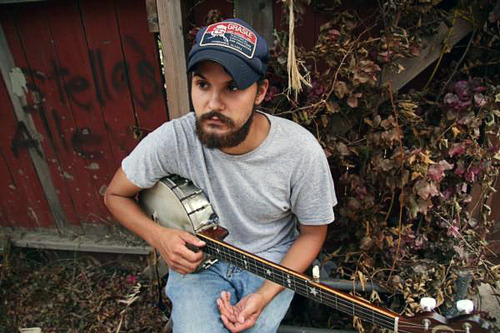
An interview with OLENTANGY JOHN
What is folk?
It’s the unanswered question. Like all art. It’s a necessary branch of any medium. Folk music is the pursuit of what makes us human and what makes us a collection of individuals that are sharing something, I guess. The old songs people keep singing come from apparently nowhere in many cases. No one knows where these songs come from. But there are the seminal versions and the bested versions. It becomes these finite points where you know there is a commonality. You can track the history of a song with all these different approaches and meanings and people involved. It’s kind of a way-point for defining oneself in the greater history of culture at large. —This is a weird answer! It’s a representation of culture.
Then is all music folk?
Yeah, basically. Folk has its elements but it’s no different than anything else. It’s made by people. For a while a friend and I had a joke, we were playing acoustic instruments and writing songs about Lewis and Clark and all these other historical references. We were calling ourselves “post-folk” music, to get over the hump of comparing ourselves to folk music as it was previously understood. It’s a rich tradition but also overwhelming. I don’t know if I can find a solid definition. It’s music that represents culture through history and in the present simultaneously.
What attracts you to folk?
It’s a lot of contradictions. That’s a particularly human thing. It has purity in its theories of religion and then all this huge violence and intense internal conflict. Reverend Gary Davis was a preacher and a blues singer. On the same record he would have these gospel tunes with his wife and the next tune is about drinking and fighting and feeling horrible. The best folk music is devoid of pretense. I am not a religious person but I find the gospel really fascinating. There’s these dark tunes that embrace death and being done with the struggle of life. Religion is supposed to give you joy and peace but it’s interesting to note how it came to be perceived as “not necessarily in this life.” Some of these songs are about how religion brings joy after life and death becomes a goal in a way. In that respect, singing old time songs is sort of a voyeuristic view of that kind of life. Part of the interest in older tunes and murder ballads is that you can take part in these horrific events. That’s a performance thing. It’s fun to sing those songs and feel what it feels like to sing them. And it informs you about your own mind.
You seem dark!
I kinda don’t live my life in a dark way but I am fascinated by dark things. I was never into death metal or dark aesthetics, but I do like the mysterious elements of these dark things. How could this happen?? What would make someone murder their wife?! What is the through-line of logic here?
Do you like cowboy stories and old Westerns?
Yeah I do. The best Westerns are the ones that start in a grounded place—they are ranching, peaceful, whatever, and then spiral into these existential in-middle-of-the-desert things, chasing this man or or running from this thing across a vast emptiness. Sean Penn talking bout Sam Shepard’s writing says, ‘What it means to be a man in a place which has no definition.’ I feel like that’s my interest in older American stuff. What it means to be a man in a place where there is no definition. They’re all looking for God—why would God let this trainwreck happen—trying to relieve pain through alcohol, through murder, through journeys. There are love stories too. Simple love stories. Take all the logic out of it and see people loving each other, enjoying love or agonizing.
Since you don’t live a life of violence or extremes like the old time tales, how do you put your story in your music?
Like the way I approach the history itself in my songs, it’s not something I try to do. I let it inform what I do. My experience influences my music. I might take ideas and theories of myself and they become horrible stories of alcoholism and bad choices. I’m a starting point. What would it be like if I was in this situation? What might this choice lead to? Looking at the choices I have made and seeing how they might continue or be fixed.
Could it get popular?
I had this thought that if I could ween my music hard enough so that, no matter what,
if I could play myself purely then it would be accessible to everyone. That’s what I find interesting about other culture’s folk music too. The human element is transcendent, it transcends any kind of boundary. What is interesting about applying the history is that it’s a process as well. It’s never over, it’s never finished. There is no end line or even a clear beginning.
Some of the things you say sound more hippie than hillbilly. Would you agree that the two subcultures share similar ideals?
They definitely have more in common than people notice.—These mystical notions. I really think it’s true. In every art form or every pursuit, if you apply yourself to it as purely as you can—it’s probably impossible to purely express yourself— but, the more accessible it will become for everyone or it could be, even if it’s not immediately accessible. There are artists that at first glance are completely confusing, but then they apply themselves purely so you can see yourself reflected in what they are expressing. Maybe that’s something both subcultures believe.
How do you access this purer form of expression?
I try my best to take all the history that I apply my time to learning and knowing and I take all that and drop it. I let it be part of who I am and my psyche but not apply it directly. The information has affected me so I just leave everything out and operationally find a subconscious level that informs what I do. Actors talk about table work. They’ll read biographical accounts about the history and culture of a certain concept. The training is that the ideas penetrate you so you can be in the moment and let it naturally inform without referencing it directly, not imitating it. I don’t try to make a museum piece or something nostalgic about what I think the music was or to represent “then,” I just make the music my own for the present moment for the present company.
Must old time and new time folk coexist separately or could they be joined?
I think they’re maintained being separate. A lot of times people are afraid of something that seems historical in that way or strict in its guidelines. I’m afraid they have to stay separate. I feel like they inform each other very much. It’s kinda problematic. John Fahey was adamant about not calling himself a folk artist. He called himself an American Primitivist. He thought folk had this connotation that was limited, with too many rules and guidelines.
You move between the indie and the traditional music circles in L.A., how did you get involved with the latter?
I had no idea what to expect from folk or American Primitive music in Los Angeles. It’s been a cool adventure to see all the different elements of it. Indie-alt-country-straight-old time, it’s all happening here. I started playing old time music because I thought that no one was taking care of it, that it was being forgotten. Only these four guys I met were playing it and keeping it alive. I just didn’t know! I had this misconception that I needed to jump in and take care of it. I learned a lot from these guys and in process realized there are a lot of people doing it. And it’s wonderful. It’s not this forgotten history. It’s fun because you feel this mysticism that involves this old string music because it’s so bizarre and uncommon. I found this kind of perspective with my own writing that felt like old time music was a straight through-line I didn’t need to reference it directly. It came from the same place as my new music was coming from. I didn’t try to marry the two, it just happened. I don’t like to differentiate between them much.
Where do you fit into the folk spectrum?
I think that I write my music. It comes from an open pot, of sorts, of the things that have influenced me and the things I find interesting and the things I am capable of. The thing I like about folk music is it’s accessible. It’s derived from simplified playing but it’s not limited to that. I write from a place of what I am capable of as a musician. I want to write things that reference the past and things that look for the future. For a while I was sort of—in joking—I was calling the music I made “the new old.” It’s sort of a trite way to say it. I like knowing the history and I like applying the history or letting the history be involved, whether I’m actively seeking it or not.
—Daiana Feuer
One Response to “An Interview With Olentangy John”
Leave a Reply
Recent Posts
Sponsors
 |
 |
 |
 |
 |
 |
[...] An interesting interview with Mr. Atzberger here. [...]